What is Global Distribution System (GDS)?
How independent hotels leverage major GDS networks—Amadeus, Sabre, and Travelport—to reach corporate travel planners and high-yield global agents.
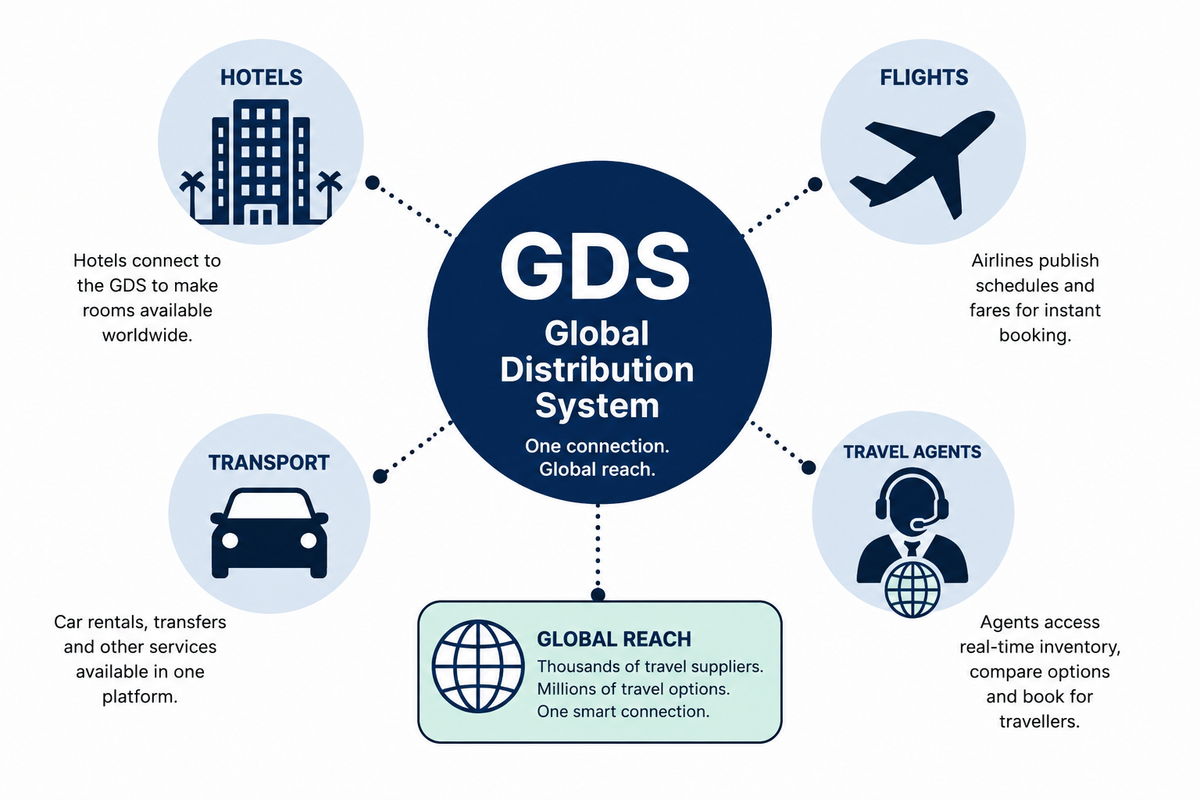
Many independent hoteliers focus all their marketing energy on direct website bookings and consumer travel sites like Booking.com or Expedia. While consumer channels generate steady leisure guests, they often miss a massive segment of high-spending business travellers and overseas tour groups. Corporate travel managers, travel agencies, and global flight booking desks rarely book through public consumer websites. Instead, they use a Global Distribution System. A Global Distribution System, commonly known as a GDS, is a specialised worldwide computer network that connects hotels, airlines, car rental companies, and travel agents in real time. For independent properties, connecting to a GDS opens the door to lucrative corporate accounts and premium global bookings that are impossible to reach through standard search channels alone. Here is everything you need to know about how GDS networks work and how they fit into modern hotel operations.
1. The Big Three: Connecting to Corporate Travel Buyers via Amadeus, Sabre, and Travelport
The primary power of a GDS lies in its established business-to-business network of travel agencies, corporate travel management companies (TMCs like Amex GBT, BCD Travel, and CWT), and corporate self-booking tools (like SAP Concur and cytric). The global travel market is powered by three major GDS platforms: Amadeus, Sabre, and Travelport. When multinational companies arrange travel for executives, sales teams, or international conferences, their corporate booking tools pull live rates and room availability directly from these GDS feeds. Listing your independent property ensures your rooms appear on corporate-approved hotel lists alongside major global hospitality chains.
2. Amadeus: European Dominance and Global Airline-Hotel Network Integration
Headquartered in Europe, Amadeus is the largest GDS platform by worldwide booking volume, processing over 40% of global travel agency transactions. Amadeus holds unmatched dominance across European, Middle Eastern, and Asian travel management desks. In addition to powering major airline reservation systems (such as Lufthansa, British Airways, and Air France), Amadeus provides extensive hotel distribution connectivity. For independent boutique properties and regional hotels looking to capture high-spending European business travellers and overseas flight-and-stay package bookings, Amadeus is an indispensable global channel.
3. Sabre: The Corporate Powerhouse Dominating North American and Global Agencies
Developed originally in partnership with American Airlines and IBM, Sabre is the undisputed market leader across North America and a dominant force in corporate enterprise travel worldwide. Sabre processes hundreds of millions of travel itineraries annually and serves as the primary distribution engine for Fortune 500 corporate travel desks, government agency contracts, and premier US travel consortia (such as Virtuoso and Signature Travel Network). Connecting your independent hotel to Sabre gives you direct visibility to corporate travel officers booking multi-night business stays, executive suites, and corporate group retreats.
4. Travelport: Galileo, Worldspan, and Apollo Agency Connectivity
Travelport is the unified global distribution powerhouse operating Galileo, Worldspan, and Apollo across more than 180 countries. Travelport has modernised legacy distribution with its high-speed, API-first Travelport+ platform. Galileo commands enormous strength across the United Kingdom, Europe, and Asia-Pacific, while Worldspan powers high-volume online travel suppliers and regional agency desks. By distributing through Travelport, independent hotels reach thousands of specialised travel advisors, corporate travel managers, and overseas inbound tour operators that do not rely on single-channel OTAs.
5. GDS vs. OTAs: Comparing B2B Corporate Distribution to Consumer Platforms
While Online Travel Agencies cater directly to everyday leisure consumers searching online, a GDS operates on a business-to-business model. OTAs charge steep percentage commissions ranging from 15% to 25% per booking. In contrast, GDS bookings typically incur a combination of a modest fixed transaction fee (usually $3 to $5), a representation fee, and standard travel agent commissions (typically 8% to 10%). Because business travellers book premium room categories, stay for multiple mid-week nights, and spend significantly on food, beverage, and amenities, GDS distribution often yields much higher net revenue and profit margins than consumer OTAs.
6. Real-Time PMS and Channel Manager Synchronisation with Amadeus, Sabre, and Travelport
In past decades, managing GDS inventory required manual rate loading and complex green-screen terminal coding. Today, modern hotel channel managers and cloud property management systems (PMS) connect seamlessly to GDS switches via two-way XML/API integrations. When you update room rates, close minimum stay requirements, or adjust room availability in your front desk system, those changes reflect across Amadeus, Sabre, and Travelport within seconds. This automated sync eliminates double bookings and guarantees rate parity across all your distribution channels.
7. Weighing Setup Costs and Transaction Fees Against High-Yield Business Stays
Connecting to a GDS involves setup fees, ongoing monthly connectivity, and per-reservation transaction fees. Because of this structure, GDS distribution is most profitable for hotels located near commercial districts, transport hubs, convention centres, university campuses, or popular international leisure destinations. Evaluating your local corporate demand allows you to decide whether GDS distribution offers the right return on investment for your operational budget.
Conclusion
A Global Distribution System is not a replacement for your direct booking engine or online marketing, but a powerful operational tool to capture high-value corporate travel. By integrating your property management system with GDS networks like Amadeus, Sabre, and Travelport, your independent hotel can compete on equal footing with international hotel chains for lucrative business contracts.
Frequently Asked Questions
What is a Global Distribution System (GDS)?
A Global Distribution System (GDS) is a worldwide computerised reservation network that connects hotels, airlines, and travel suppliers with corporate booking tools and travel agencies in real time. It enables independent properties to distribute live room rates and inventory directly to high-yield business travellers, corporate planners, and overseas travel management companies.
What are the major Global Distribution Systems (GDS) in hospitality?
The three major legacy GDS platforms operating worldwide today are Amadeus, Sabre, and Travelport (which includes Galileo, Worldspan, and Apollo).
Can small independent hotels connect to Amadeus, Sabre, and Travelport?
Yes. Independent hotels and boutique properties can easily access GDS networks through a modern hotel channel manager or GDS representation partner without needing direct chain affiliations.
How do GDS fees compare to OTA commissions?
GDS reservations usually involve a fixed booking transaction fee ($3-$5), a representation fee, and an 8 to 10 percent travel agent commission, which often results in lower overall cost than 18 to 22 percent OTA commissions on multi-night corporate stays.
What types of guests book through a GDS?
GDS bookings are primarily driven by corporate business travellers, government employees, conference attendees, airline crew, and clients of luxury travel advisors.