Voice Search on Smart Displays: How AI Recommends Accommodation on Nest and Alexa
How conversational AI assistants on smart home displays extract structured local entity data and schema markup to serve hands-free, voice-activated hotel recommendations for travellers.
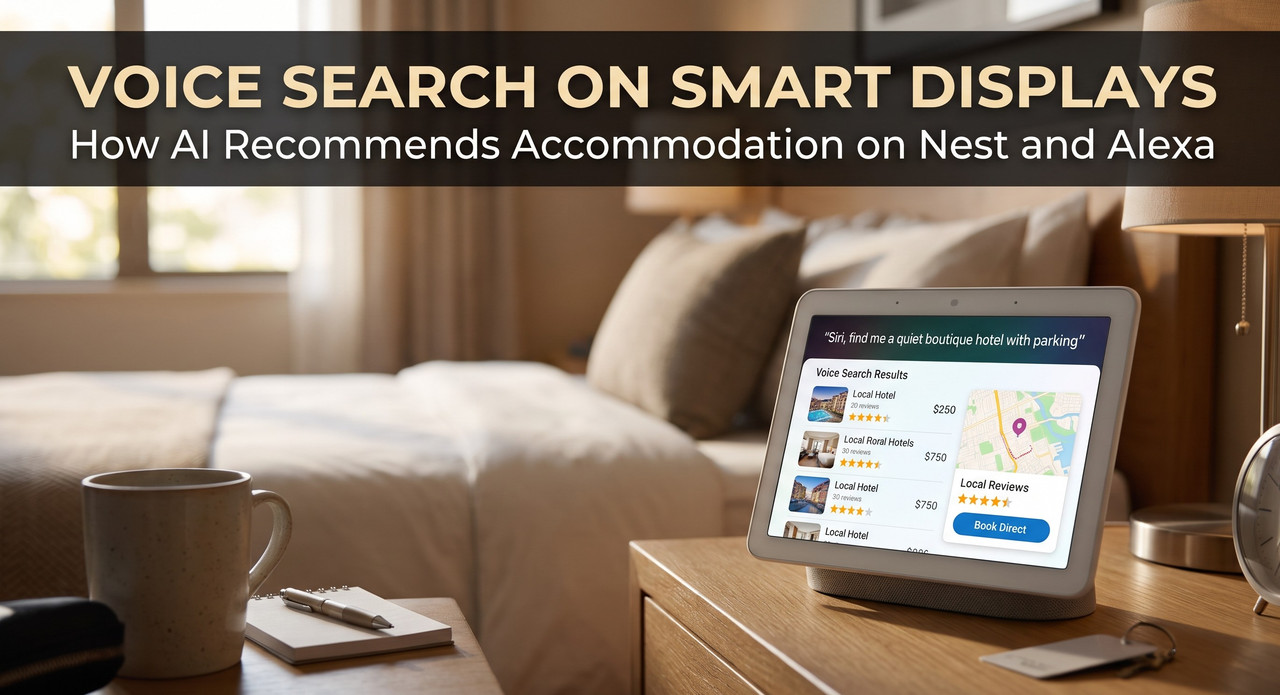
Millions of travellers now plan weekend trips and business stopovers from their kitchen counters and living rooms by speaking directly to smart displays. Spoken queries like "Hey Google, find a boutique hotel near the waterfront with free parking" or "Alexa, recommend a family motel near the city centre" trigger a completely different search process than traditional desktop browsing. Unlike conventional search result pages that display ten blue links and rows of sponsored ads, smart displays like the Google Nest Hub and Amazon Echo Show operate with severe visual constraint. A voice assistant typically selects only one or two top recommendations, speaking a short audio summary while displaying a single interactive visual card. For independent hotels, winning this coveted smart display recommendation does not require paying exorbitant commissions to aggregators. Instead, it demands crystal clear structured data, verified local entity mapping, and conversational search optimisation that AI assistants can interpret without ambiguity.
Step 1: Structure Your Website with Conversational Lodging Schema Markup
Smart assistants do not have the patience to parse convoluted website layouts or buried PDF brochures. They rely directly on structured schema markup embedded in your page code to understand operational facts instantly. Implement comprehensive `LodgingBusiness` and `HotelRoom` JSON-LD schema containing explicit attributes for check-in hours, pet policies, parking availability, and room dimensions. Pair this with [self referencing canonical tags](/blog/how-canonical-tags-protect-your-hotels-google-ranking) to ensure voice crawlers always index your primary source of truth. Structured markup gives the voice assistant the high statistical confidence it requires before reading your hotel details aloud.
Step 2: Sync Verified Binary Attributes Across Google Business Profile and Bing Places
Voice AI on Google Nest draws heavily from Google Maps entity databases, while Amazon Alexa relies on Bing Places and regional local directories. Discrepancies in your address, phone number, or core operational attributes across these platforms will immediately cause voice assistants to disqualify your property. Ensure every binary attribute—such as wheelchair accessible entrance, complimentary breakfast, electric vehicle charging, and air conditioning—is verified on both platforms. Aligning these profiles mirrors the best practices in our [Google Business Profile checklist for AI visibility](/blog/the-hoteliers-google-business-profile-checklist-for-ai-visibility) and ensures search algorithms confirm your property matches exact spoken guest constraints.
Step 3: Connect Your Hotel to Open Knowledge Graphs and Wikidata
Conversational AI models power smart displays by cross referencing open knowledge graphs to verify that an accommodation provider is a legitimate physical business. If your hotel lacks an established entity identity, voice assistants default to large corporate chains. Establish your hotel's presence in open knowledge repositories with verified geographical coordinates and official website links. Binding your direct website to these open records through `sameAs` schema confirms your entity status across the web. To understand how open graph databases feed conversational recommendations, review our guide to [hotel Wikidata entity optimisation](/blog/how-open-knowledge-graphs-feed-ai-travel-search-engines).
Step 4: Cultivate Semantic Review Mentions for High Intent Voice Queries
When a traveller asks a voice assistant for a "quiet hotel with comfortable beds", the AI scans recent review snippets for semantic corroboration rather than generic star ratings. Spoken search engines prioritize properties where real guest feedback explicitly confirms operational quality. Encourage departing guests to mention specific room features, acoustics, and hospitality touches in their post stay feedback. Cultivating detailed review comments gives conversational models the operational proof needed to endorse your hotel. Learn how search algorithms extract sentiment details in our guide on [how conversational AI analyses micro reviews](/blog/how-conversational-ai-analyses-micro-reviews-to-evaluate-hotel-service-consistency).
Conclusion
Voice search on smart displays is the purest expression of answer engine optimisation: you are either the single recommended answer or you do not exist. By structuring your website schema, synchronising local map profiles, and verifying your entity in open knowledge graphs, you position your independent property directly in front of hands-free travellers. As conversational travel planning expands, hotels that provide clean machine readable data will capture high intent direct bookings before guests ever touch a screen.
Frequently Asked Questions
How do smart displays choose which hotel to recommend?
Smart displays evaluate proximity, verified Google Business Profile and Bing Places attributes, structured website schema, and sentiment consistency in recent guest reviews to deliver the single most relevant local match.
Can guests book hotel rooms directly through voice search?
Yes. Voice assistants display visual cards on smart screens linking directly to official booking engines or Google Free Booking Links, enabling guests to complete reservations without paying third party commissions.
What is the difference between smartphone voice search and smart display search?
Smart displays combine spoken audio responses with visual cards on a stationary screen, requiring concise spoken answers backed by high-resolution imagery and direct booking touchpoints.
Does having an FAQ page help with voice search on Alexa and Nest?
Yes. Clear question-and-answer format marked up with FAQPage schema provides conversational search engines with pre-formatted snippets that can be read aloud directly in response to spoken guest inquiries.