Preparing Your Hotel’s Digital Footprint for 2027 AI Travel Agents
How independent hoteliers can audit entity data, verify AI discovery profiles, and refresh structured schema before the new year.
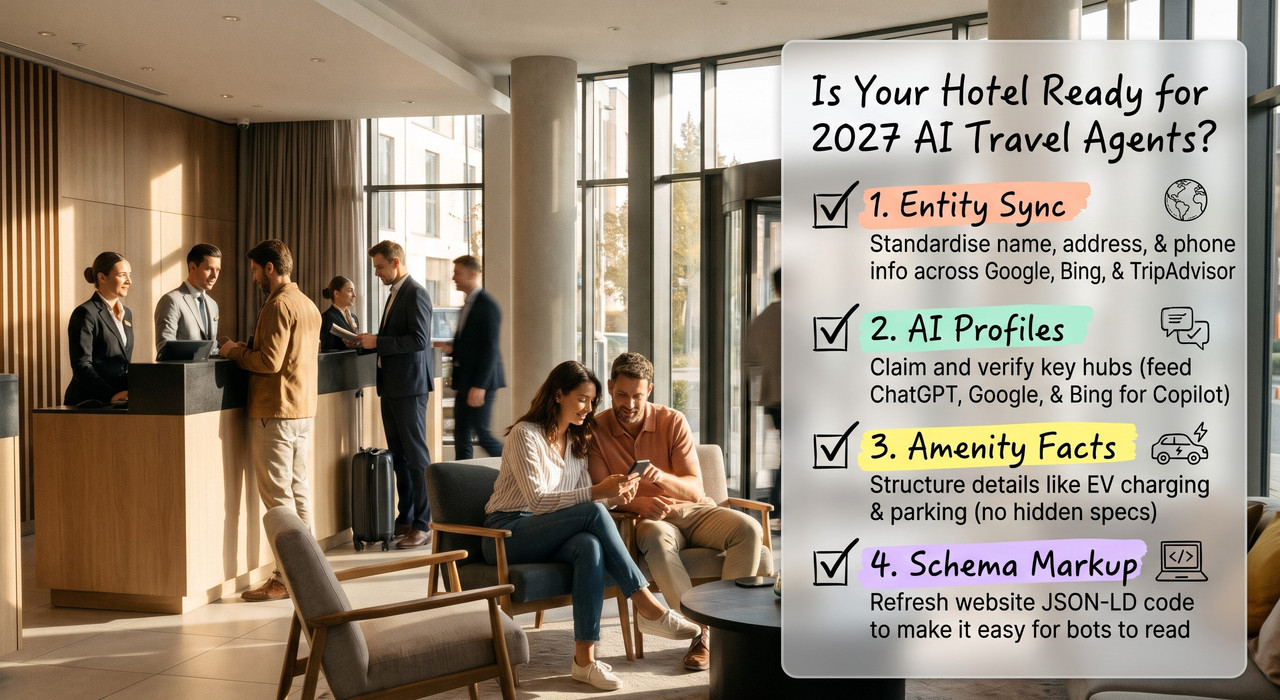
As the year draws to a close, travellers are already planning their 2027 holidays, weekend breaks, and business trips. Increasingly, those journeys do not begin with ten blue links on a traditional search engine. Instead, guests are asking conversational AI platforms, such as ChatGPT, Google AI Mode, Gemini, and Microsoft Copilot, to research destinations, compare room types, and shortlist properties on their behalf. Unlike traditional web crawlers that simply index keywords, 2027 AI travel agents act like digital concierges. They cross-reference structured data, verified business profiles, real-time rate feeds, and guest review sentiment before recommending a hotel. If your property’s digital footprint contains outdated details or missing attributes, AI assistants will quietly skip over you in favour of competitors or Online Travel Agencies (OTAs). Taking a few hours before the new year to audit and align your core digital profiles ensures your independent property starts 2027 visible, verified, and ready to capture direct bookings. ### 4 Essential Year-End Steps to Make Your Hotel AI-Ready for 2027 Rather than overhauling your entire website, focus your year-end preparation on four foundational data checks that power AI discovery. **🔧 Implementation Blueprint:**
Standardise Your Core Entity Data (NAP Consistency)
Check that your hotel’s official name, street address, phone number, and primary website URL match character-for-character across your website footer, Google Business Profile, Bing Places, TripAdvisor, and local tourism directories. Conflicting details lower AI confidence scores and prevent your property from being cited.
Claim and Verify Your Key AI Discovery Profiles
AI assistants pull heavily from verified business ecosystems. Ensure your [Google Business Profile is updated for AI visibility](/blog/the-hoteliers-google-business-profile-checklist-for-ai-visibility) for Gemini and Google AI Mode, verify your listing on [Bing Places for Business](/blog/why-hoteliers-cant-ignore-bing-places-for-business) for Microsoft Copilot, and claim your property profile through [OpenAI’s Businesses in ChatGPT rollout](/blog/openais-businesses-in-chatgpt-rollout-a-strategic-guide-for-hotel-leaders-and-marketers) so your direct brand facts are locked in.
Turn Hidden Amenities into Structured Facts
Travellers ask AI agents very specific questions, such as "Which boutique hotels near the waterfront offer free EV charging and late check-out?" Do not bury these details inside PDF brochures or generic paragraphs. List parking rules, Wi-Fi speeds, pet policies, accessibility features, and check-in times clearly in plain text on your website and business profiles.
Refresh Your Website’s JSON-LD Schema Markup
Schema markup acts as a translator between your website and AI crawlers. Before 2027 begins, verify that your homepage includes a clean `Hotel` or `LodgingBusiness` schema detailing your star rating, check-in hours, geo-coordinates, price range, and amenity features, alongside `FAQPage` schema for common guest questions. For a deeper look at technical markup, review [the hidden ROI of structured data](/blog/hidden-roi-structured-data-schema-metadata).
Conclusion
Preparing your digital footprint before the new year gives independent hoteliers an immediate advantage as 2027 travel planning accelerates. By locking in consistent entity data, verifying key discovery profiles, surfacing plain-text amenities, and refreshing your JSON-LD schema, you give AI travel agents complete confidence to recommend your direct website over OTAs. Ready to benchmark your current standing? Start with our [5-Point AI Audit every hotel needs today](/blog/the-5-point-ai-audit-every-hotel-needs-today).
Frequently Asked Questions
How do 2027 AI travel agents decide which independent hotels to recommend?
AI assistants evaluate a combination of verified business listings, consistent website schema markup, live rate connectivity, and recent guest review sentiment. Properties with clear, structured facts and strong service consistency are recommended ahead of sites with vague marketing copy.
Do independent hotels need a massive budget to appear in AI search results?
No. Unlike paid search ads, AI visibility relies primarily on data accuracy, technical clarity, and verified business profiles. A well-structured independent website with up-to-date Google Business Profile and Bing Places listings can outperform larger chains that neglect their local entity data.
How often should hoteliers audit their digital footprint for AI visibility?
Conduct a comprehensive entity and schema audit every quarter, and update your business profiles immediately whenever you change seasonal hours, renovate rooms, add new facilities, or launch direct booking packages.