How Apple Intelligence & Local Entity Data Are Changing Hotel Discovery
How on-device personal context, Siri App Intents, and verified local entity schemas are transforming hotel discovery—and how independent hoteliers can capture direct bookings.
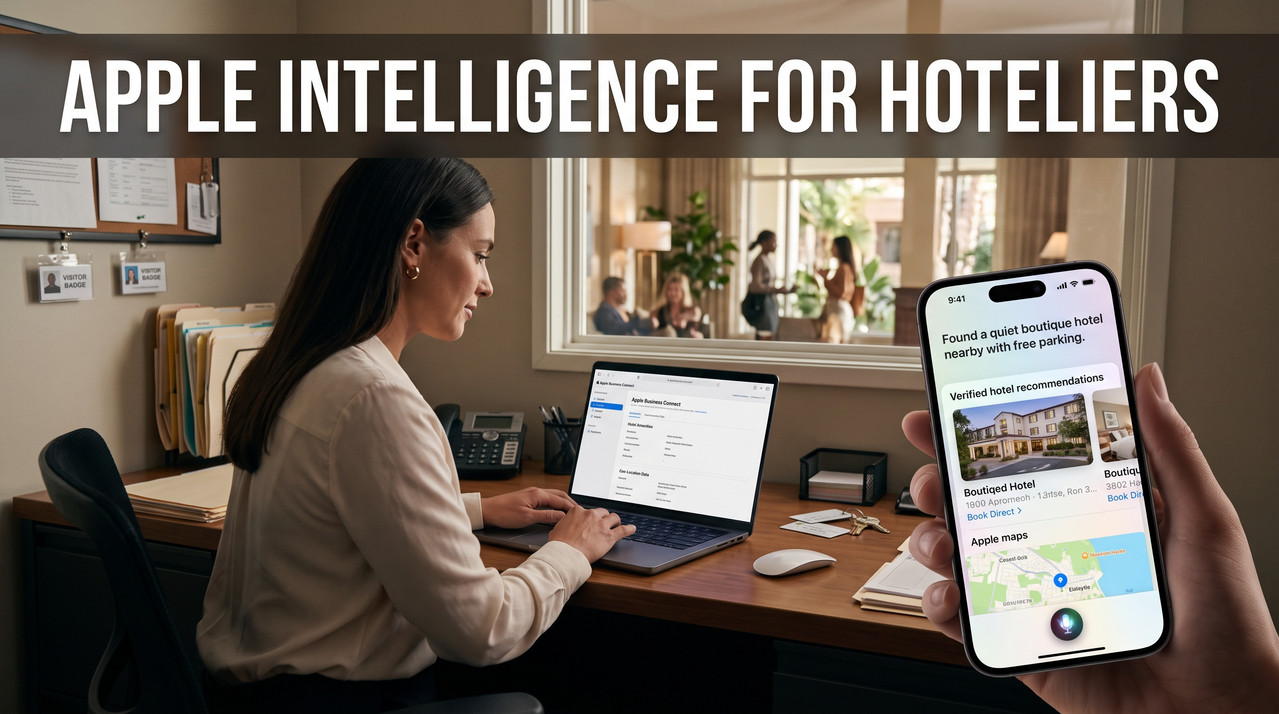
The arrival of Apple Intelligence marks a profound turning point in how travellers search for, evaluate, and book hotel accommodation. For over two decades, digital hotel discovery followed a predictable pattern: a traveller typed keywords into a browser, scanned a page of blue links or OTA ads, and navigated through competing browser tabs. Apple Intelligence shatters this search paradigm. By fusing on-device Personal Context Understanding with deep operating system integration across iOS, iPadOS, and macOS, Apple devices no longer simply retrieve web pages. Instead, they act as ambient, context-aware travel assistants that synthesize emails, calendar commitments, flight itineraries, and real-time location with structured real-world data. At the heart of this transformation is **Local Entity Data**. In an AI-mediated ecosystem, machines do not index your hotel as a collection of keywords; they interpret your property as a verifiable, distinct entity with physical coordinates, live amenities, operating policies, and relational connections. For independent hotels, understanding how Apple Intelligence perceives and retrieves entity data is now the difference between winning high-margin direct bookings or vanishing from the traveller's digital journey.
The Shift from Keyword Queries to Personal Context & On-Device AI
### 1. The Death of Generic Keyword Search * **Context Over Keywords**: Travellers no longer need to type "boutique hotel near downtown with parking". Apple Intelligence already knows the traveller's schedule, arrival flight, family size, and preferences through its private on-device semantic index. * **Proactive Trip Synthesis**: By cross-referencing upcoming calendar dates and flight reservations, Apple devices surface lodging recommendations before the traveller ever opens a browser search bar. ### 2. On-Device Reasoning & Privacy Architecture * **Apple Silicon & Private Cloud Compute**: Apple Intelligence processes sensitive personal context directly on the user's device, escalating complex queries to Private Cloud Compute without storing user identities or telemetry data. * **Algorithmic Trust**: Because users trust Apple's strict privacy model, they give Siri and on-device features full permission to manage travel itineraries, making conversational AI recommendations their primary booking guide.
Why Local Entity Data Is the New Currency of Hotel Visibility
### 3. Entities Over Web Pages * **Knowledge Graphs as the Foundation**: Search engines and Apple Intelligence map the physical world through Knowledge Graphs. A hotel is not just a URL—it is a defined entity with unique identifiers (Place ID, Wikidata, and Schema.org LodgingBusiness). * **Algorithmic Confidence & Disambiguation**: When an AI assistant recommends a property, it requires 100% confidence that the data is factual. Inconsistencies between your official website, Apple Maps, Google Business Profile, and directories degrade algorithmic confidence, causing assistants to pass over your property. ### 4. The Power of Schema.org sameAs Markup * **Machine-Readable Proof of Identity**: Establishing unambiguous digital identity through Schema.org `sameAs` links your website directly to your Apple Maps Place Card, Wikipedia/Wikidata entities, and review profiles. * **Canonical Authority**: Explicit entity links prove to AI web crawlers that your official website and direct booking engine represent the canonical source of truth.
Apple Maps Place Cards & Siri App Intents: The New Direct Booking Front Door
### 5. Place Cards as Interactive Storefronts * **Rich Digital Showcases**: Apple Maps has evolved far beyond simple turn-by-turn navigation. Modern Place Cards feature high-definition photography, editorial travel guides, curated Local Lists, and direct booking call-to-action buttons. * **Zero-Click Discovery**: Travellers explore room categories, check reviews, and view key amenities directly inside Apple Maps without visiting third-party comparison sites. ### 6. Siri App Intents & Hands-Free Recommendations * **Direct Voice & System Actions**: With deep App Intents integration, users command Siri to "find boutique hotels near my conference venue with EV charging". * **Frictionless Conversion**: If your hotel's booking engine and local listings provide structured intent data, Siri can surface your direct rates with zero friction, bypassing OTA middleman fees.
The Hidden Danger of Entity Hallucinations & Fragmented Amenities
### 7. The Heavy Cost of Conflicting Data * **Data Hallucinations**: When AI models encounter conflicting information across the web—such as mismatched check-in times, disputed pet fees, or inconsistent breakfast hours—they either hallucinate incorrect facts or omit the hotel entirely to avoid risk. * **OTA Default Trap**: If an OTA listing provides cleaner structured amenity data than your official website, AI assistants will cite the OTA as the primary booking source, costing your hotel 15% to 25% in commissions. ### 8. Machine-Readable Property Fact Sheets * **Structured FAQ Pages**: Maintaining an up-to-date, structured FAQ page and deep room amenity schemas on your website ensures that AI crawlers always pull real-time, accurate rates and policies directly from your property.
The Hotelier's 5-Step Action Plan for Apple Intelligence Readiness
### Step 1: Claim and Verify Apple Business Connect * **Audit Your Listing**: Claim your Apple Maps listing through Apple Business Connect immediately. Ensure your exact property name, physical address, phone number, high-resolution photography, and direct website booking links are verified. ### Step 2: Deploy Comprehensive LodgingBusiness Schema * **Deep Structured Code**: Implement structured JSON-LD code on your homepage and room pages, explicitly specifying check-in/out hours, `petsAllowed`, `amenityFeature` arrays, and direct booking URLs. ### Step 3: Unify Your Entity Footprint with sameAs * **Reconcile Web Profiles**: Add verified links to your Apple Maps Place Card, Google Business Profile, TripAdvisor, and social accounts within your schema header to resolve entity ambiguity. ### Step 4: Write Conversational, Intent-Focused Content * **Answer Guest Intent**: Structure website pages around the exact micro-moments and natural-language questions guests ask (e.g., "Late check-in policy for business travelers" or "Secure covered parking for tall vehicles"). ### Step 5: Audit Your AI Visibility Regularly * **Monitor Assistant Responses**: Prompt Siri and conversational answer engines with local lodging prompts to verify how your property is summarized, correcting any discrepancies across digital touchpoints immediately.
Conclusion
**Turn AI Discovery into Your Most Profitable Direct Channel** The rise of Apple Intelligence is not a distant trend—it is active across hundreds of millions of premium Apple devices globally. Travellers are moving rapidly from manual search comparisons to ambient, AI-curated recommendations. Independent hotels that proactively structure their local entity data, claim their Apple Business Connect profiles, and implement robust Schema.org markup will command the digital real estate of tomorrow. By presenting search assistants with clear, authoritative, and machine-readable facts, you position your property as the undeniable first choice for travellers—capturing direct bookings and protecting your operating margins.
Frequently Asked Questions
How does Apple Intelligence discover hotels compared to traditional Google Search?
Traditional search relies on matching user keywords to indexed web pages and bidding for ad auctions. Apple Intelligence uses on-device semantic understanding to evaluate the traveller's personal context (emails, calendar entries, upcoming flights) and matches it with verified real-world entity data from Apple Maps, Apple Business Connect, and Schema.org markup to deliver direct, context-aware recommendations.
What is local entity data and why does it matter for hotels?
Local entity data refers to structured, machine-readable facts that uniquely identify your hotel as a real-world entity in search knowledge graphs. This includes your physical address, geocoordinates, room amenities, operating policies, and official booking links. High entity clarity gives AI systems the algorithmic confidence required to recommend your property over competitors.
How do independent hotels get featured in Apple Maps and Siri travel prompts?
Hoteliers should claim and optimize their profile in Apple Business Connect, ensure high-resolution photos and accurate amenities are displayed, connect direct booking partners, and deploy Schema.org LodgingBusiness markup with complete sameAs arrays on their website.
Does Apple Intelligence favor OTAs over direct hotel websites?
Apple Intelligence prioritizes algorithmic accuracy and direct utility for the user. When a hotel provides verified, direct booking URLs and rich structured entity markup on its official site, AI assistants can surface the direct channel. However, if a hotel lacks structured data and an OTA provides clean metadata, the assistant will default to the OTA.